
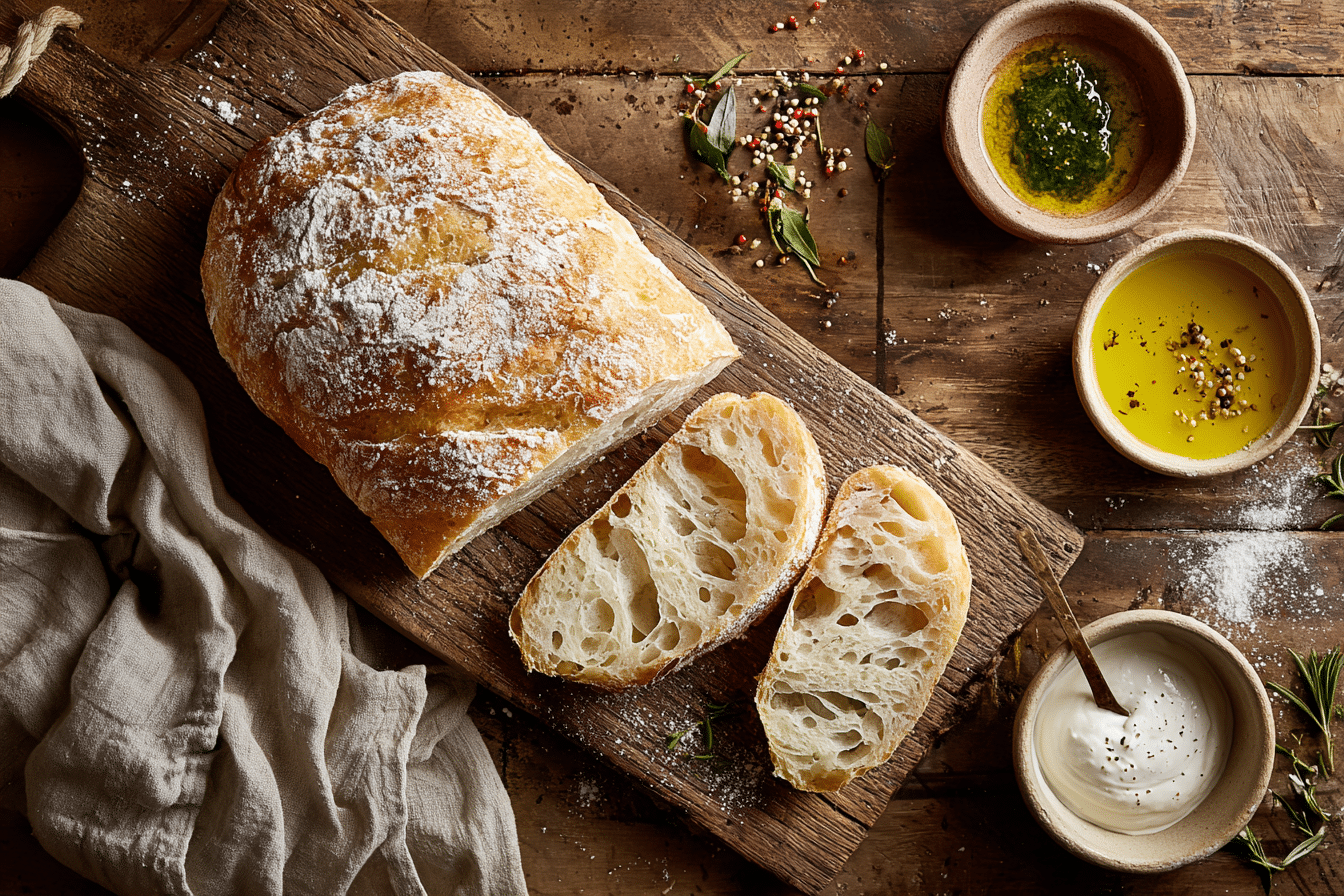
No-knead ciabatta is the ultimate bread for home bakers who crave artisan results with minimal effort. Originating in Italy in the 1980s as a response to French baguettes, ciabatta (meaning “slipper”) earned its name from the flat, elongated shape that resembles a worn shoe. But what sets ciabatta apart is its open crumb, chewy crust, and delicate interior that’s full of beautiful air pockets.
This no-knead version relies on time rather than elbow grease. With just a few pantry staples and a long fermentation, you’ll be rewarded with a rustic loaf that looks and tastes like it came straight out of a European bakery. The dough is wet and sticky — that’s the secret to its airy structure — and all it asks from you is patience.
Whether dipped in olive oil, piled with deli meats, or turned into a panini, this ciabatta is as versatile as it is beautiful.
Ingredients Overview
This minimalist recipe relies on quality ingredients and a high-hydration dough. Here’s a closer look at each element and how it contributes to the final loaf.
Bread Flour
-
Why it matters: Bread flour has higher protein content (11–13%) than all-purpose, which gives the dough its signature chew and allows gluten strands to form during fermentation.
-
Substitute: All-purpose flour works in a pinch, but expect a slightly softer crust and smaller holes.
Instant or Active Dry Yeast
-
Function: A tiny amount of yeast is enough to give this dough life over a slow rise. It creates those gorgeous air pockets and gives the bread its subtle flavor.
-
Tip: If using active dry yeast, bloom it in warm water first. Instant yeast can go straight into the flour.
Lukewarm Water
-
Hydration is key: This dough is nearly 80% hydration, meaning it’s very wet. That moisture translates to a light, airy interior with irregular holes — the hallmark of ciabatta.
Salt
-
Flavor and structure: Salt enhances the taste and strengthens gluten development during the long fermentation.
Olive Oil (Optional)
-
Adds depth: Some ciabatta recipes call for a small amount of olive oil for tenderness and flavor. It’s optional but traditional in some Italian variations.
Ingredient Tips
-
Filtered water is ideal if your tap water is heavily chlorinated, which can affect yeast activity.
-
Cold fermentation is possible — you can refrigerate the dough overnight for even more flavor.
Step-by-Step Instructions
Step 1: Mix the Dough (No Kneading Required)
-
In a large bowl, mix 3 1/4 cups (400g) bread flour, 1 1/2 tsp salt, and 1/4 tsp instant yeast.
-
Add 1 1/2 cups (360ml) lukewarm water. Mix with a wooden spoon or spatula until all the flour is hydrated and you have a sticky, shaggy dough.
-
Cover with plastic wrap or a damp towel and let rest at room temperature for 12–18 hours. The dough should rise and become bubbly.
Step 2: Shape the Dough
-
Generously flour your work surface. Gently scrape out the dough using a bench scraper — do not punch it down.
-
With floured hands, stretch the dough gently into a rectangle about 10×6 inches. Use your fingertips to dimple the surface slightly — this prevents over-inflation and retains the airy texture.
-
Fold one short end of the dough halfway over the center, then fold the other end on top, like folding a letter. Let rest for 30 minutes, covered with a towel.
Step 3: Second Rise (Proof)
-
Transfer the dough seam-side down onto a parchment-lined baking sheet. Shape gently into a rough slipper shape, handling it as little as possible to preserve bubbles.
-
Cover with a towel and let proof for 45–60 minutes until slightly puffy.
Step 4: Bake
-
Preheat oven to 450°F (230°C). Place a baking stone or steel (if you have one) on the center rack and a metal pan on the bottom rack for steam.
-
When ready to bake, slide the ciabatta (still on parchment) onto the stone or a hot baking sheet.
-
Pour 1 cup of hot water into the lower pan to create steam, and quickly close the oven door.
-
Bake for 22–25 minutes until golden brown, with a crisp crust and hollow sound when tapped.
-
Cool on a wire rack for at least 30 minutes before slicing — the crumb continues to set as it cools.
Tips, Variations & Substitutions
-
Don’t be tempted to add more flour. The dough should be wet and sticky — resist the urge to make it manageable.
-
Use a bench scraper and floured hands to handle the dough easily.
-
Add-ins: Fold in chopped olives, sun-dried tomatoes, or roasted garlic during the stretch and fold step for a flavored version.
-
Whole wheat version: Substitute up to 25% of the bread flour with whole wheat flour for a slightly nuttier flavor.
-
No baking stone? Use an inverted baking sheet that’s been preheated for a crispy bottom crust.
Serving Ideas & Occasions
This ciabatta fits seamlessly into both casual and elegant meals.
-
Classic pairing: Dip slices in extra-virgin olive oil with balsamic vinegar.
-
Sandwiches: Slice horizontally for paninis, Caprese sandwiches, or Italian subs.
-
Breakfast: Toast with salted butter, honey, or smashed avocado.
-
Holiday meals: Serve alongside soups, roasted meats, or cheese platters.
-
Everyday meals: Use it to soak up saucy pasta or as a base for bruschetta.
Its chewy, airy interior and golden crust make it an excellent canvas for nearly any topping or filling.
Nutritional & Health Notes
Ciabatta is a simple bread with just four main ingredients — no preservatives, sugars, or processed oils.
-
Calories: Around 120–140 per slice (depending on size).
-
Macronutrients: Mostly carbohydrates with a small amount of protein and minimal fat (unless olive oil is added).
-
Lower sodium option: Reduce the salt slightly, but keep in mind it plays a role in flavor and texture.
For those watching their gluten intake, this recipe is not gluten-free, though high-hydration gluten-free ciabatta recipes do exist using blends of rice flour, tapioca, and psyllium husk.
This bread is best enjoyed in moderation as part of a balanced diet — it’s satisfying without being heavy.
FAQs
Q1: Can I use all-purpose flour instead of bread flour?
Yes, but the crumb may be slightly less open and chewy. Bread flour is ideal due to its higher protein content, which helps trap air and create large holes.
Q2: Why is my ciabatta dough so sticky?
That’s normal! Ciabatta dough is high in hydration. A sticky dough creates an airy crumb — use floured hands and a bench scraper instead of adding more flour.
Q3: Can I refrigerate the dough overnight?
Absolutely. Cold fermentation improves flavor. After mixing, cover the bowl and refrigerate for up to 18 hours. Let it come to room temp before shaping.
Q4: What if I don’t have a baking stone?
Preheat a heavy-duty baking sheet upside down and bake your ciabatta on top. You’ll still get a nicely browned bottom crust.
Q5: Can I freeze baked ciabatta?
Yes. Let it cool completely, wrap tightly in foil and plastic wrap, and freeze for up to 2 months. To reheat, thaw and warm in a 350°F oven for 10–15 minutes.
Q6: How do I get those big holes inside?
High hydration, minimal handling, and proper fermentation are key. Don’t overwork the dough — stretch and fold gently, and avoid deflating it before baking.
Q7: How long does ciabatta stay fresh?
Ciabatta is best the day it’s baked. Store at room temp in a paper bag for 1–2 days. For longer storage, freeze it. Avoid plastic bags — they soften the crust.
PrintBatch Baking Ciabatta Bread Simple, Rustic, and Delicious
This no-knead ciabatta features a light, airy crumb and crisp crust with just a few ingredients and zero kneading. Perfect for sandwiches, dipping, or slicing warm out of the oven.
- Prep Time: 10 minutes
- Cook Time: 25 minutes
- Total Time: About 13–14 hours
- Yield: 1 loaf (about 10 slices) 1x
Ingredients
-
3 1/4 cups (400g) bread flour
-
1 1/2 tsp salt
-
1/4 tsp instant yeast
-
1 1/2 cups (360ml) lukewarm water
-
1 tbsp olive oil (optional)
Instructions
-
Mix flour, salt, and yeast in a large bowl. Add water and stir until you get a sticky, shaggy dough.
-
Cover and let rise at room temperature for 12–18 hours until bubbly.
-
Flour your surface and gently stretch dough into a rectangle. Fold like a letter and rest for 30 minutes.
-
Shape into a rough loaf on parchment and let proof for 45–60 minutes.
-
Preheat oven to 450°F with a baking stone or sheet. Place a pan on the bottom rack for steam.
-
Transfer dough (with parchment) to the oven, add hot water to bottom pan, and bake 22–25 minutes until golden.
-
Cool on wire rack before slicing.
Notes
Dough is very wet — use floured hands and avoid overhandling. For extra flavor, refrigerate overnight after the initial mix.